Ore-ida: Tot Protecting Pants

Problem: Ore-Ida invented the Tater Tot, but over time, cheap knockoffs and price-focused shoppers put its position at risk. With many choosing cheaper options, Ore-Ida needed to reclaim its place as the original and best.
Insight: When everyone copies, the original always stands out.
Idea: Ore-Ida has a strong pop culture connection, especially through Napoleon Dynamite, where Tater Tots became a cult symbol. To celebrate the film’s 20th anniversary, we launched a nostalgic and playful campaign featuring Tot-Protecting Pants.
The pants were styled after Napoleon’s look and had a “bully-resistant” pocket. Jon Heder returned to his role for the first time in 20 years to launch the product. The campaign started with teaser posts on social media, followed by a :30s commercial on Hulu and Disney+. Partnerships with Hulu and Jimmy Kimmel Live expanded the campaign’s reach. The pants were sold exclusively on Amazon, sold out quickly, and soon appeared on eBay for hundreds of dollars, becoming a collector’s item.
Results: The pants sold out almost immediately. The campaign was covered by 478 outlets, including NBC, CBS, ABC, People, E! News, and Complex, with international coverage increasing the reach. It generated over 88M social views and 412M earned media impressions. Sales grew 7.5%, and Napoleon Dynamite reached Hulu’s Top 10, showing Ore-Ida not only brought back Tots but made them popular again.
Awards:
Shorty Awards 2025
- Winner: Comedy Video
- Gold: Multi-Platform Partnership
ADC Awards 2025
- 2x Merit: Entertainment & Product Design
Heinz: Run on Heinz
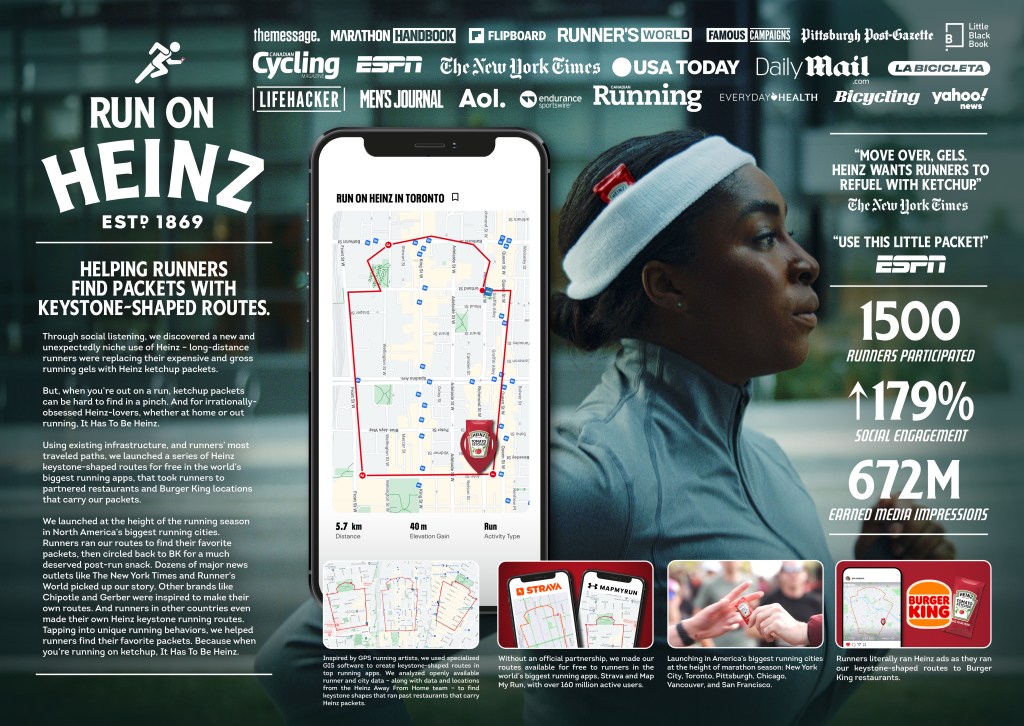
Problem: Social listening on Reddit revealed a niche use for Heinz: long-distance runners were swapping pricey, unappealing gels for ketchup packets. However, finding Heinz on the go during a run isn’t always easy.
Insight: For irrationally-obsessed Heinz fans, whether at the table or out on a run, it has to be Heinz.
Idea: Our target was runners using our packets and the broader running community. To engage them directly, we tapped into their favorite running apps and the global trend of GPS art. Using the apps’ built-in functionality, we designed keystone-shaped routes guiding runners to our packet locations. Heinz created keystone-shaped routes in six major North American cities: New York City, Vancouver, Toronto, Pittsburgh, Chicago, and San Francisco. Using GIS mapping software, the routes utilized existing infrastructure and highlighted Heinz-partnered restaurants where runners could grab free ketchup packets. The maps were accessible for free on Strava and MapMyRun, the world’s largest running apps with over 160 million users.
Results: The campaign reached 672M earned media impressions, with 1500 runners joining in and a 179% increase in social engagement. The campaign inspired international coverage, appearing in major outlets as The New York Times, USA Today, and Runner’s World. It also prompted other brands like Chipotle and Gerber to join in the fun.
Awards:
Drum Awards 2024
- Gold: Data and Insights
- Silver: Digital, Mobile App
Shorty Awards 2024
- Gold: Creative Use of Technology
- Gold: Insights & Trends
The One Show 2024
- Merit: Direct
ANA In-House 2024
- Winner: Branded Content
Heinz: MEANT TO BE
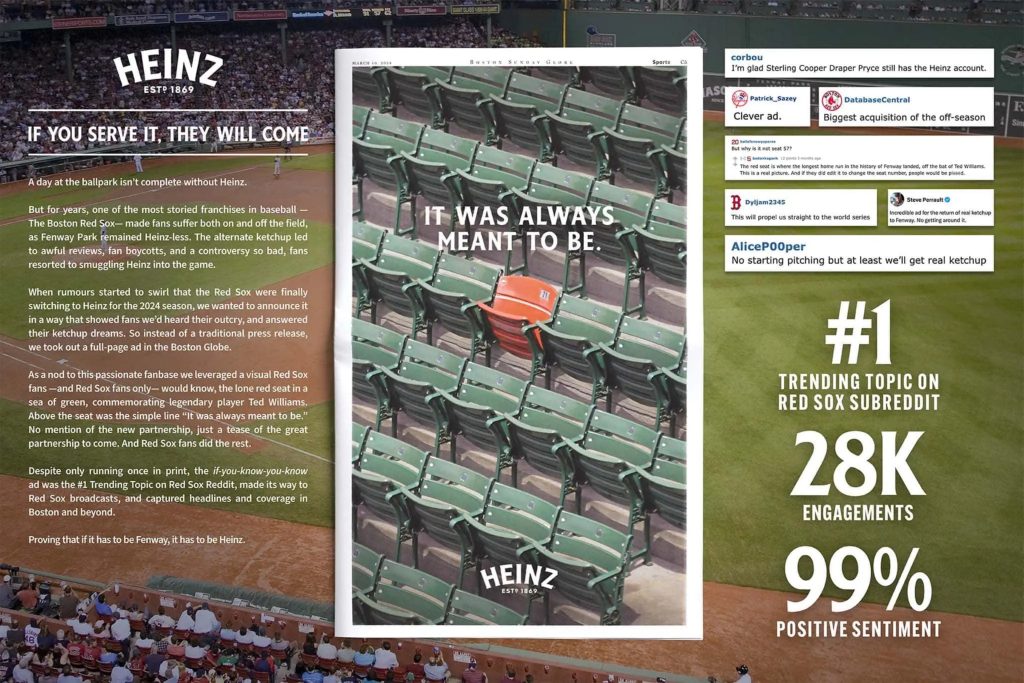
Problem: For years, Fenway Park didn’t carry Heinz ketchup, leaving fans so dissatisfied that they resorted to sneaking it into the stadium.
Insight: A day at the ballpark isn’t complete without Heinz.
Idea: As rumors swirled about Heinz returning in 2024, the brand seized the moment to celebrate the comeback and make a splashy announcement. Rather than issuing a standard press release, Heinz placed a bold full-page ad in The Boston Globe, signalling to fans that their voices had been heard, and finally, that Fenway was carrying Heinz ketchup again.
Results: The campaign became the #1 trending topic on Red Sox Reddit, with fans celebrating the brand’s comeback
Awards:
ADCC Awards 2024
- Silver: Print & OOH
Oscar Mayer: Sing to pay
Problem: Oscar Mayer has been around for over 140 years, but its relevance has faded with younger audiences.
Insight: In 2024, smiles are down, literally. The U.S. dropped out of the world’s top 20 happiest countries. In tough times, nostalgia isn’t just comforting, it’s needed.
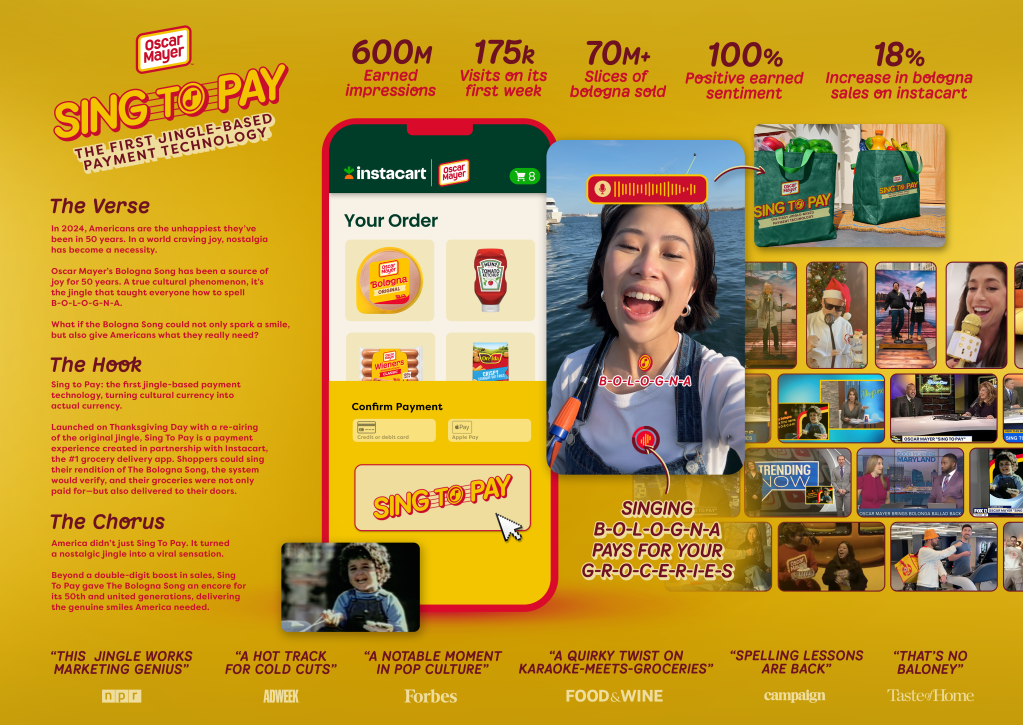
Idea: To mark 50 years of The Bologna Song, Oscar Mayer turned its iconic jingle into a form of payment. Introducing Sing to Pay: the first jingle-based payment system. In partnership with Instacart, people could sing the song, upload their version, get the lyrics verified, and Oscar Mayer would cover their grocery bill. Available nationwide on any device, no credit card needed—just a tune.
The campaign launched with the original 1974 TV spot during the NFL playoffs during Thanksgiving weekend, sparking a wave of nostalgia. A social rollout followed, with TikTok creators leading the charge and fans responding with remixes, family duets, and opera versions. We took it offline too; capturing real people singing to pay on campuses, subways, and bars. User content drove the campaign’s momentum, outpacing paid media and making the jingle go viral all over again.
Results: “Sing to Pay” became Oscar Mayer’s most positively received campaign ever. It generated over 600M earned impressions and 600 media placements. In the first week alone, 175K shoppers visited Instacart through the campaign, driving an 18% lift in bologna sales with over 70M slices sold in total.
Awards:
Clio Awards 2025
- Bronze: Social Media
Oscar Mayer: Save Bacon Hairs
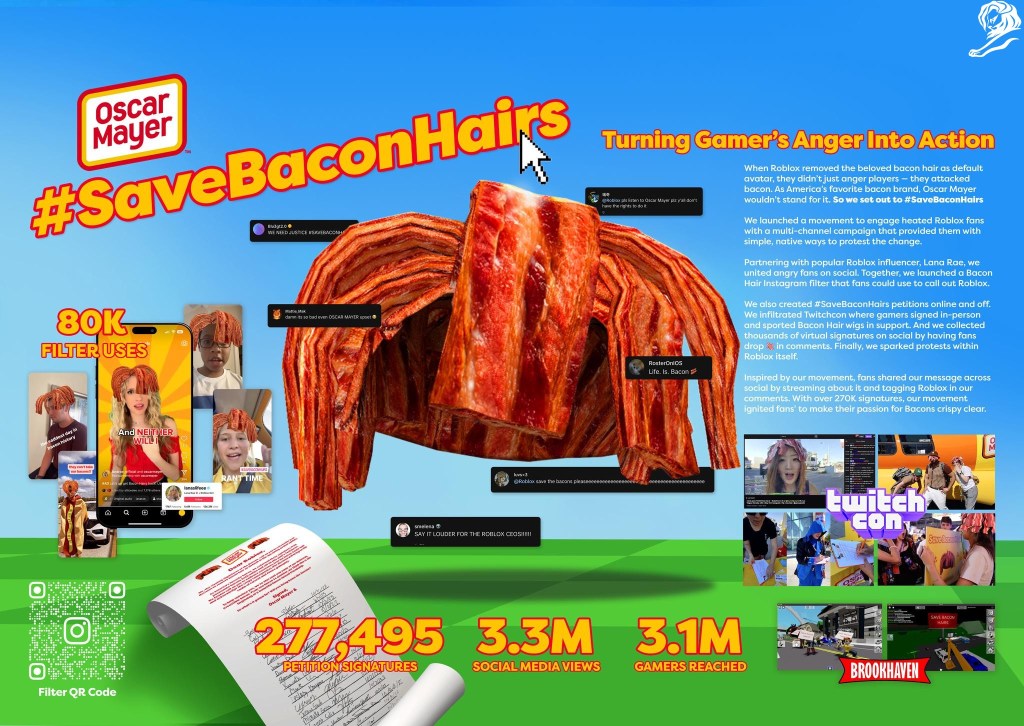
Problem: Roblox announced the removal of its iconic “Bacon Hair” avatar, sparking outrage among gamers who saw it as a beloved symbol of the game’s culture.
Insight: Removing Bacon Hair, a default Roblox avatar, is like taking away the heart of the game.
Idea: Oscar Mayer seized the moment to join the conversation, leveraging its connection to bacon and its playful brand purpose of sparking smiles. We launched #SaveBaconHairs, a digital campaign rallying fans to challenge Roblox’s decision. By collecting petition signatures through bacon emojis and engaging fans on social, in-game, and at TwitchCon, we turned their passion into action.
Results: The campaign reached 3.1M gamers, drove 3.3M social views, and secured over 277K petition signatures. It generated a 7% increase in bacon sales and sparked private conversations with Roblox about reinstating Bacon Hair.
Awards:
The One Show 2024
- Bronze Pencil: Direct Marketing
Drum Awards 2024
- Silver: Social & Integrated
Shorty Awards 2024
- Gold Honor in Multi-Platform Campaign
- Silver Honor in Branded Content
- Bronze Honor in Food & Beverage
Kraft Real Mayo: Search Moist
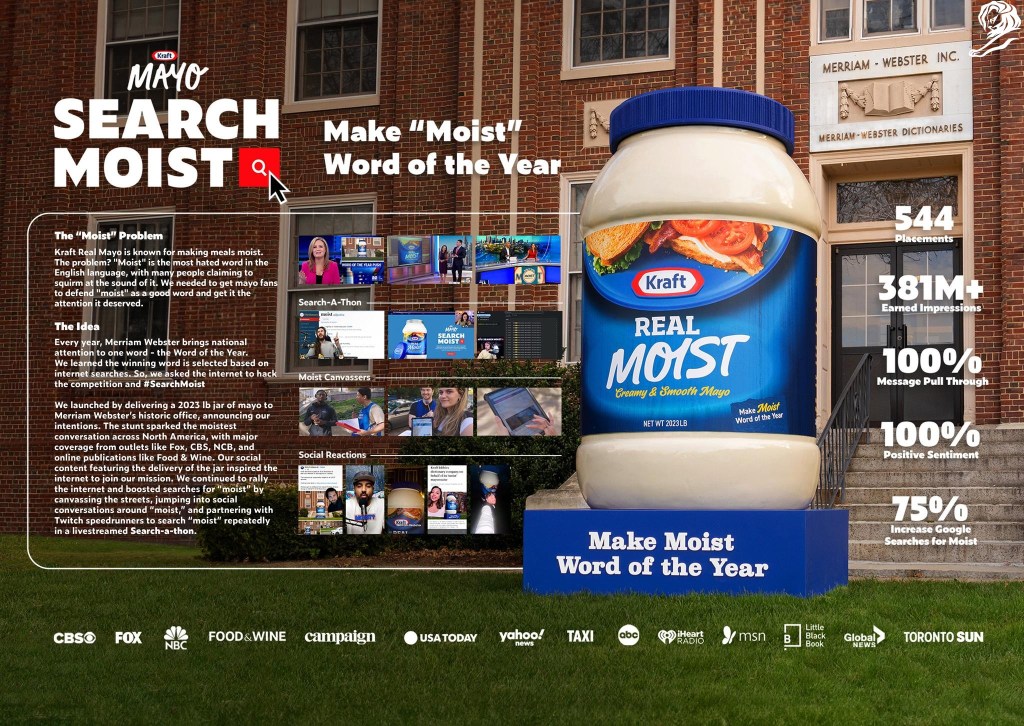
Problem: Kraft Real Mayo is known for making food ‘moist,’ but ‘moist’ is one of the most disliked words in the English language.
Insight: Kraft Real Mayo makes “moist” something to own, not cringe at.
Idea: Kraft aimed to reclaim the cringed-at word “moist,” transforming it into a point of pride for unapologetic mayo lovers through humor and a playful embrace of internet cringe culture. The campaign sparked buzz with meme-worthy content, influencer collaborations, and interactive stunts. Key tactics included promoting “moist” as 2023’s Word of the Year, creating social ads that triggered smart devices to “Search Moist,” hosting Twitch “Search-A-Thons,” and delivering a 8-foot jar of Kraft Mayo to Merriam-Webster’s office.
Results: Kraft’s campaign to redeem the word “moist” gained widespread internet and media support, driving a 75% increase in Google searches and over 21K visitors to Merriam-Webster’s website. Though “moist” didn’t win Word of the Year, fans rallied with slogans like “Justice 4 Moist” and “Moist 2024,” signalling a shift in public perception. With 544 media placements, 381 million impressions, and coverage from outlets like FOX, CBS, NBC, and Food & Wine, the campaign made a splash, most notably with the mysterious disappearance of an 8-foot Kraft Mayo jar from Merriam-Webster’s office, leaving only tire tracks behind.
Awards:
Shorty Awards 2024
- 2x Gold: Event & Experiential & Other Platform Partner
- Silver: Micro-Influencer Strategy
- Bronze: Call to Action
Clio Awards 2024
- Shortlist: Social Media
The One Show 2024
- 2x Merit: Public Relations & Social Media
ANA In-House 2024
- Winner: OOH
Canadian Tire: Shhh
Problem: With countless loyalty programs vying for attention, consumers feel overwhelmed and underwhelmed, seeing these programs as transactional and impersonal. In fact, 90% of consumers have a negative perception of loyalty programs, finding little value in what’s offered (Capgemini, 2021).
Insight: Triangle Select feels almost too good to be true.
Idea: Canadian Tire introduced Triangle Select, its premium subscription program, with a playful twist. Instead of a big announcement, the campaign featured a Canadian Tire employee whispering the news to a surprised customer, conveying that the program is so good it feels like a secret. The omni-channel campaign spanned Linear TV, OOH, paid social, digital banners, and native TikTok videos.
Results: The campaign helped grow Triangle Rewards membership to 11.3 million, demonstrating its success in driving engagement.
City of Toronto: DO NOT Feed
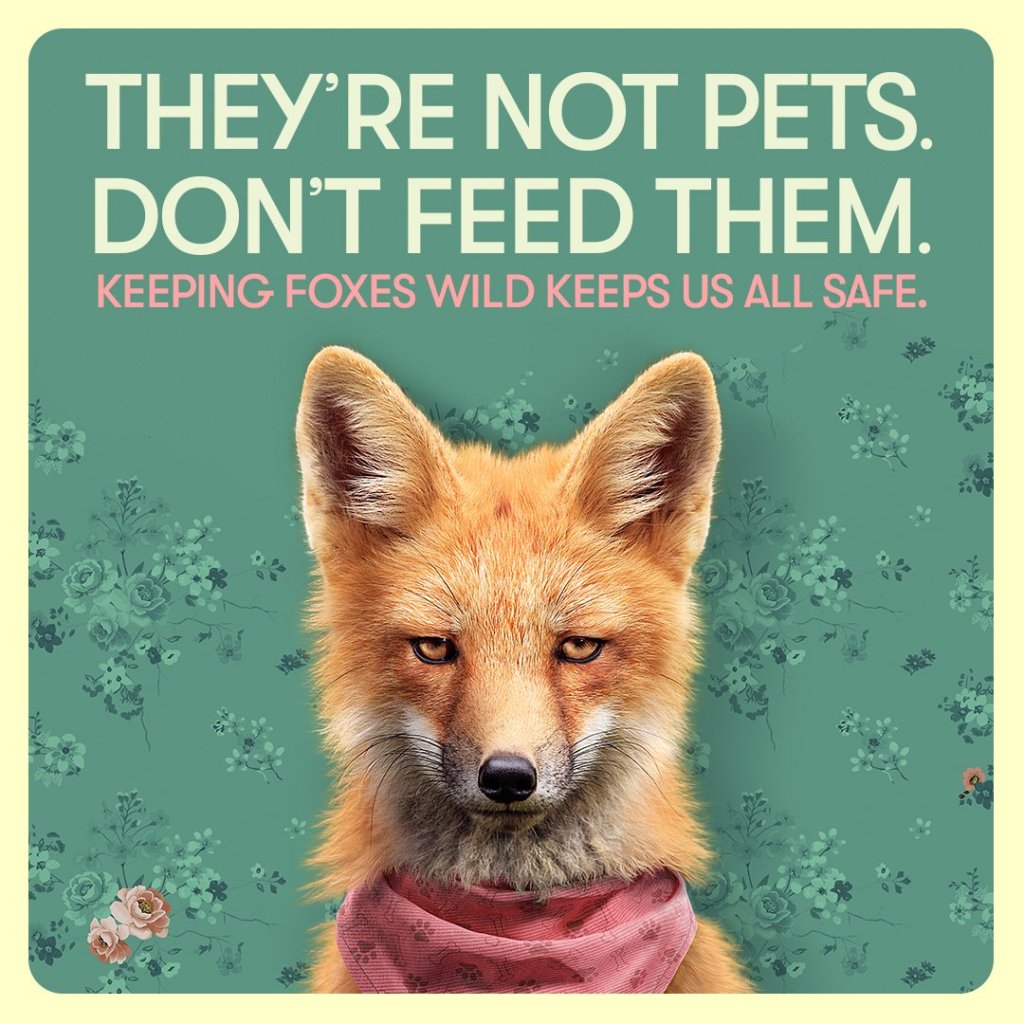
Problem: Feeding wildlife in Toronto was on the rise, posing risks to both humans and animals. The City of Toronto launched the “Don’t Feed Wildlife” campaign to educate residents about changes to the Animals By-law which prohibits residents from feeding wildlife.
Insight: To stay alive, wildlife must stay wild.
Idea: The campaign highlighted how wildlife, though deceptively cute, are not pets. By placing animals like coyotes and foxes in pet accessories, the visuals emphasized that feeding them disrupts their natural instincts. The message: admire them, but let them stay wild to ensure safety for both animals and humans. This campaign launched in OOH, digital and social.
Results: The campaign sparked a viral frenzy. A transit ad featuring a bowtie-wearing coyote was shared by comedian Chris Betts with the caption, “THEN WHY IS HE WEARING A BOWTIE? I WANT TO GIVE HIM SPAGHETTI.” The tweet garnered 3.1M views, 115K likes, and 13.3K retweets in three days. It also inspired engagement from meme pages, brands like Goodfood, and media outlets including BlogTO, CP24, and the Toronto Star.
City of Toronto: Alarm CHECK

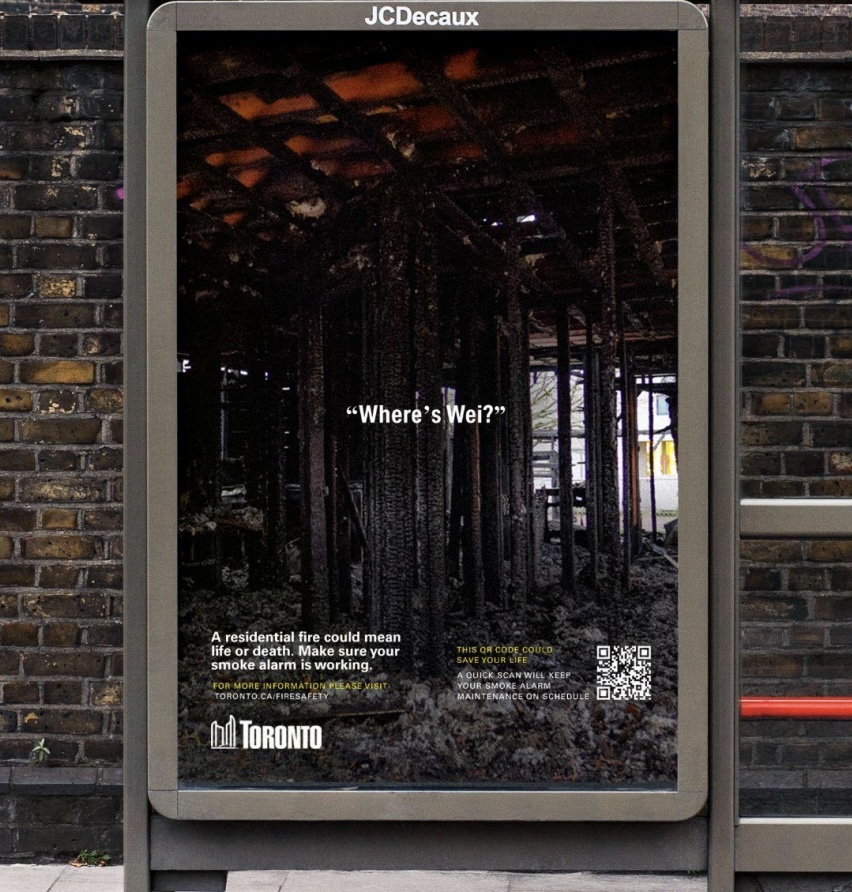
Problem: 59% of fires in single-family residential homes across the city were in homes that did not have a working smoke alarm. Fire can spread rapidly through a home, leaving those in the building with as little as one or two minutes to escape safely once the smoke alarm sounds.
Insight: A fire doesn’t just consume belongings, it destroys lives.
Idea: Dark, striking visuals revealed the true devastation of fires, loss that goes far beyond property. OOH ads near brick buildings showed burned interiors, underscoring the dangers of neglecting smoke alarm maintenance. The campaign extended across social media and direct mail, featuring a QR code that prompted biannual battery checks.
Results: The campaign reached 90,000 high-risk households, delivering visually impactful materials and practical tools to encourage smoke alarm maintenance and testing.
City of Toronto: Toronto for All


Problem: Islamophobia and misconceptions about being Muslim persist in Toronto. The City of Toronto needed a campaign to encourage allies to stand against micro and macro aggressions faced by Muslim communities.
Insight: Our ignorance misleads us to believe what’s not true.
Idea: Torontonians pride themselves on being polite and welcoming, but their openness often comes with unspoken conditions. Using the asterisk, a symbol for exceptions, we challenged Toronto’s “conditional acceptance” of Muslim people. The campaign urged residents to “Accept Without Exception,” embracing Muslims fully, including their hijabs, prayer times, and beliefs. Real, local Muslims were cast as models featured in transit posters, social posts, and digital banners.
Results: Local media highlighted the campaign’s strong impact, with officials pointing out its role in promoting inclusivity and tackling discrimination. Councillor Shelley Carroll and Aasiyah Khan from the National Council of Canadian Muslims both emphasized how the campaign helped boost community engagement and collaboration in fighting hate and promoting respect for Muslim cultural practices. This resulted in greater awareness and a stronger shared commitment to addressing discrimination.
 Monika Hesch